Refrigerator Repair
No Ice After the City Dug Up Your Block: Lead Service Lines, Particulate and the Sub-Zero Inlet Valve
Chicago has more than 400,000 lead water service lines, more than any other city in the United States, because the municipal plumbing code required them right up until the federal ban took effect in 1986. The pipe feeding a kitchen in Lincoln Park, Lakeview, Roscoe Village or Lincoln Square is very likely one of them. When the street outside is opened, the appliance that notices first is the one making ice.
The part of the year that matters
Street work runs on a warm-weather calendar. The months when a block gets opened for main replacement, meter installation or a lead service line swap are the months that set up an ice fault you will not see until much later. That delay is the entire reason nobody ever connects the two events.
The exposure is not shrinking quickly either. WTTW News reported that fewer than four percent of the city’s confirmed and suspected lead lines had been replaced over the previous five years, so for most of these blocks the disturbance is still ahead of them rather than behind. And it is not only the big projects: hydrant work, a meter installation in the basement, or a neighbour’s private-side replacement all shake the same run of pipe.
What the swing asks of the machine
A Sub-Zero ice maker and dispenser tap that service line through a quarter-inch supply and a solenoid inlet valve with a fine screen at its throat. That valve is a timed metering device. It opens for a fixed interval and assumes a fixed pressure behind it. It has no way at all to compensate for a supply that has quietly lost pressure or picked up grit.
Disturbing an old line releases decades of scale in suspension. The particulate travels until something stops it, and the two things that stop it are the inline filter cartridge and that inlet screen. Then the city’s own post-work advice compounds the effect entirely reasonably: the Department of Water Management recommends an NSF-53 certified filter for the first three months after construction work on the line, and a five-minute flush after any six hours of non-use. Households add point-of-use filtration ahead of the appliance, the cartridge loads with the same sediment, and static pressure at the valve drops below what it needs to meter a full fill.
The failure it produces, and when
The sequence is consistent enough to diagnose over the phone. Cubes get smaller and go hollow first, because the mould is filling partway before harvest. Then they start fusing into a slab in the bin, because half-formed cubes carry water with them. Then production stops. Dispensed water thins from a stream to a dribble somewhere in the middle of that.
The timing is what hides the cause. This shows up weeks after the excavation, sometimes a season later, and by then the street is repaved and the homeowner is convinced the ice maker has failed.
There is an opposite version worth knowing. If grit holds the valve off its seat instead of blocking the screen, the fault reverses: continuous slow fill, water overflowing the mould, a sheet of ice under the bin and a fill tube frozen solid. Same root cause, mirror-image symptom, and it is the more damaging of the two because the overflow finds its way down into the cabinet.
Getting ahead of it
If your block has been dug this year, treat the supply as dirty until it proves otherwise.
Flush the cold kitchen tap for a full five minutes after any stretch of six hours or more without use, which is the Department of Water Management’s own guidance, and keep an NSF-53 filter on for the first three months after work on your line. Change the appliance’s inline cartridge on a date rather than waiting for a symptom, because a loaded cartridge is silent right up until the ice goes small. Know where your shutoff is before you need it — in Lakeview and Roscoe Village it is often behind cabinetry or at the bottom of a rear stair, and finding it during an overflow is not the moment.
Two things not to do: do not feed a built-in from a saddle valve, and do not respond to slow ice by turning the water pressure up somewhere else in the house.
What we do on the visit
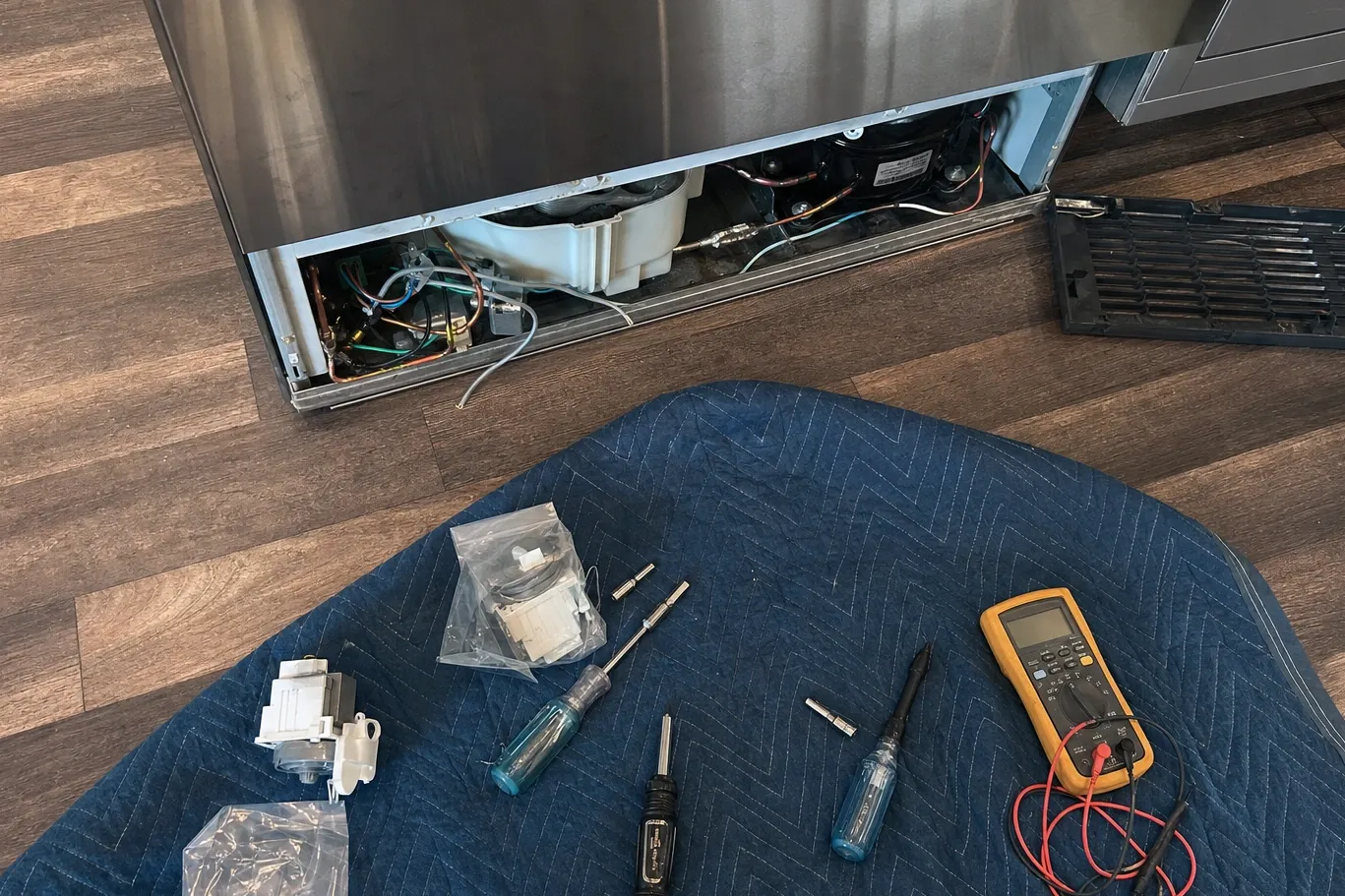
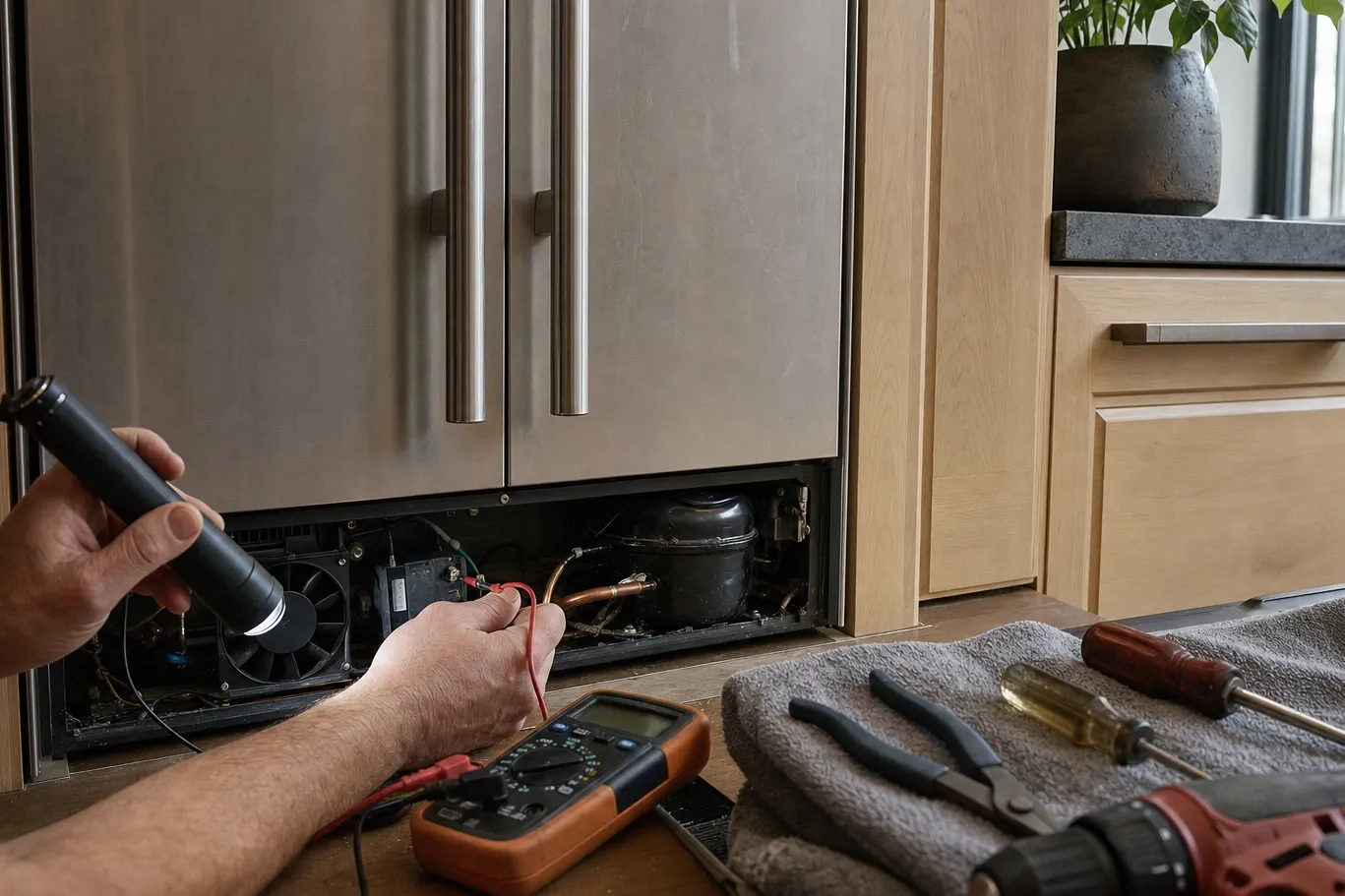
The order matters, because each step rules out the one after it. We verify at the shutoff rather than at the appliance, to see whether pressure and volume exist at all. We bypass the filter and retest, which separates a loaded cartridge from everything else in about two minutes. We time a measured fill into a container to see whether the valve is metering to spec or short. Only then does the valve come out so the screen can be inspected under light, and the fill tube and its heater get checked for the overflow variant. The ice maker module, the mould thermostat and the harvest cycle are looked at last, because they are the parts most often replaced for someone else’s problem.
Diagnosis is 89 dollars. Ice maker, water valve or supply line work falls in a 280 to 740 dollar band on this site. If the visit turns out to be about temperature rather than water, the relevant bands are 290 to 630 dollars for a door gasket or seal, 330 to 650 dollars for an evaporator or condenser fan motor, 260 to 630 dollars for a defrost heater, thermostat or sensor, 440 to 980 dollars for an electronic control board, and 1,440 to 3,160 dollars for compressor or sealed-system repair.
When you book, mention any street or plumbing work near the property in the last year, even if it seemed unrelated. In a garden-level Lincoln Park kitchen or a Lincoln Square courtyard building, that one detail regularly turns a diagnostic into a finished repair on the same visit. Either book above or call (312) 651-6937 — the same visit either way.
Follow-ups
- The city replaced a water line on my street months ago. Could that really be why my ice maker stopped?
- Yes, and the delay is typical. Excavation releases scale that has been settled in the pipe for decades, and it accumulates gradually in the inline cartridge and the inlet-valve screen. Fill volume drops before it stops, so you see small hollow cubes for weeks first. By the time production ends, the street work is long finished and nobody connects the two.
- Will a new filter fix small hollow ice cubes?
- Sometimes, and it is the cheapest thing to try first. Fit a fresh cartridge, discard the first several fills, and give it a day. If the cubes are still short, the restriction has moved past the filter into the inlet-valve screen, and that needs the valve out. Chicago's water department also advises an NSF-53 filter for the first three months after construction work on your line.
- What should I do if water is overflowing inside the freezer instead?
- Shut the supply off at the valve behind or below the appliance and call. That pattern usually means grit is holding the inlet valve off its seat, so it never fully closes. Left running, the overflow freezes around the fill tube and works down into the cabinet, which turns a valve job into a much longer one. Ice maker, water valve and supply line work runs 280 to 740 dollars here.